Remove echo from audio
Recorded in a big, empty room? fix.fm hears the echo, tells you how bad it is and cuts it down. Free, in your browser, and nothing is uploaded.
Never uploaded. Everything runs in your browser.
What's happening
Echo is the sound of the room answering back. Your voice bounces off bare walls, floors and windows and reaches the mic a moment later, over and over, until it fades. In a small, furnished room that fade is quick and you never notice it. In an empty room, a kitchen or a bathroom it can ring on for a second or more, and each word smears into the next.
fix.fm times the decay in pauses. Its warnings start around 0.45 s and increase at 0.7 and 1.1 s. These are heuristic thresholds, not a room-acoustics certification. Without enough pauses, the result can be uncertain. Hear echo beside hiss and hum to distinguish a room tail from a continuing noise bed.
How far the echo fix goes
The echo fix turns down the part of the sound that arrives late, after bouncing round the room. How much it can do depends on how long the room rings and on whether the check can hear the room at all. The three cases below are the same dry reading in two software rooms, the bigger one also under hiss, so we know what was said and can measure what came out, what was left, and when the fixer gave up.
One dry reading put in two software rooms, and the bigger one also given hiss, then run through this page's fixer at full amount. Every clip is matched to -23 LUFS so only the room differs.
Dry reading
The reference. Each word stops when the reader stops.
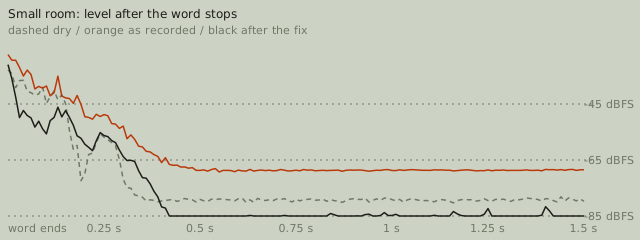
Small room, 0.55 s
A furnished room with a hard floor. The words carry a short ring, clearest on the last word before a pause.
Small room, after the fix
The ring is gone from the pauses. The voice keeps its first reflections, so it still sounds like a room, not a booth.
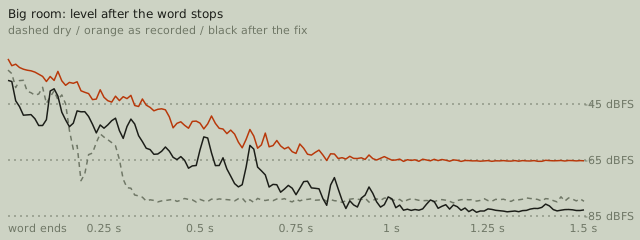
Big room, 1.4 s
An empty hall. Every word smears into the next and the pauses never go quiet.
Big room, after the fix
The tail is shorter and the pauses drop faster, but the words still sound wet. The fixer can turn the room down; it cannot take the voice out of it.
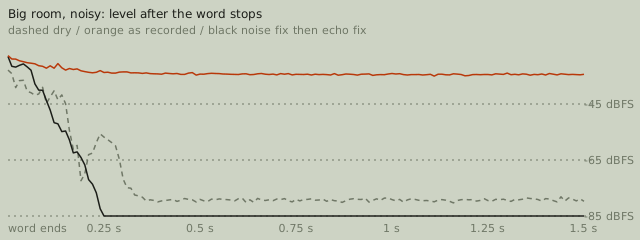
Big room with hiss 12 dB under
The same hall with a noisy preamp. The hiss fills the pauses where the tail would show.
Noisy room, echo fix alone
Identical to the recording. The check could not hear the room through the hiss, so it did nothing.
Noisy room, noise fix then echo fix
Both fixes, in the order fix.fm runs them. The hiss is gone, the room is timed and trimmed, and the pauses go quiet.
Public-domain LibriVox voice. The rooms are a software reverb with a set decay time and the hiss is white noise; no real hall or preamp was recorded. So the dry version really is what was said.
| Case | The check | Tail 300 ms after the word |
|---|---|---|
| Dry reading | 0.10 s, fine | -75.3 dBFS |
| Small room | 0.52 s, mild to 0.28 s, fine | -57.3 to -72.2 |
| Big room | 1.23 s, severe to cannot tell | -41.9 to -50.6 |
| Big room, noisy | cannot tell to cannot tell | -33.6 to -33.6 |
| Noisy, noise fix then echo fix | cannot tell to 0.24 s, fine | -33.6 to -109.8 |
The small room is the case the fixer finishes. The check times it at 0.52 s, mild; after the fix it reads 0.28 s and fine, and the tail 300 ms after a word is down 14.9 dB, close to the dry reading's -75.3. The first reflections, the part that makes a voice sound like it is in a room rather than a box, arrive too early to count as tail and are left in.
The big room shows the fixer's edge. It takes 8.7 dB off the tail, and that is clearly audible, but the words themselves were recorded wet, with the room mixed into every syllable, and no late-tail subtraction can separate them again. After the fix the check reads "cannot tell" rather than a time, because what is left no longer fades at one steady rate. That is not a pass. It means the room is no longer simple enough to time, and your ears are the judge from there.
The noisy room is why fix.fm runs the noise fix first when you pick both. Under hiss the pauses never fall far enough to show a slope, the check says it cannot judge the room, and the echo fix on its own returns the file unchanged. With the noise taken out first, the room is timed at 0.24 s and trimmed, and the pauses end up at -109.8 dBFS, quieter than the dry reading's own, which is the noise fix clearing the floor rather than the echo fix doing more.
What this does not prove: a software reverb decays at one rate across the whole spectrum, and real rooms do not; a kitchen rings longer in the low mids than up high, and the check reads one number for all of it. A room is also not the only thing that repeats: a speaker feeding back into a mic on a call is a different problem that this check reads as no room at all, room reverberation vs call feedback shows why. How we test has the pass marks behind the check.
How it works here
- 01
Times the room
It finds the moments your voice stops and measures how long the room keeps ringing after.
- 02
Trims the tail
It turns down the late ring that smears your words, keeps the short early bounce that sounds natural, then brings the level back up.
- 03
Stays on your computer
Your file is never uploaded. The whole fix runs in this browser tab.
Questions
Can it remove echo completely?
No, and nothing can without changing the voice. The echo fix is in beta. It takes the edge off a ringing room so words are easier to follow, but a very echoey recording will still sound like it was made in a big room.
Is my audio uploaded anywhere?
No. The file is read and fixed inside this browser tab and never leaves your computer. There's no account and nothing to wait for but your own machine.
Why does it say it can't tell how echoey my file is?
It needs a few pauses to hear the room ring out. If someone talks nonstop, or music or noise fills every gap, there's no clean fade to time. Try a longer clip with natural breaks.
How do I stop echo next time?
Get the mic closer to your mouth, a hand's width if you can. Then add soft things around you: a rug, curtains, a sofa, even a closet full of clothes. Bare walls and hard floors cause most echo.
Should I fix noise or echo first?
Let fix.fm handle the order. When you pick both, it takes the noise out first and the echo after, because the echo fix works better on a clean voice.